
Our Blog
Fascinating finds from the St Nicholas Square site

Jan
Archaeological investigations were carried out by Colchester Archaeological Trust at St Nicholas Square, Colchester, Essex, between October 2023 and June 2025, as part of groundworks for the redevelopment of the square into a new public space in the heart of the city.
Archaeological excavations are not just about walls and streets. They also recover the objects and materials that shaped how buildings looked, how they functioned, and how spaces were experienced. Following on from the evidence for major Roman buildings discussed in our previous post (link to previous post here), a small number of exceptional personal finds, architectural fittings, and an important assemblage of decorative building stone from St Nicholas Square help bring those spaces to life.
A pair of connected Roman gold rings
One of the most eye-catching discoveries was a pair of small conjoined Roman gold finger-rings, recovered from the soil within the former graveyard. Although they were no longer in their original Roman context, their presence alone is significant.
Gold objects of this kind are rare and would only have been owned by people of considerable status. Their discovery here reinforces the idea that this part of Roman Colchester was a wealthy and important area of the city.
The two rings are small, probably made for a child, and are unusual in that they physically join together along their plain hoops. Both are complete, although slightly distorted.

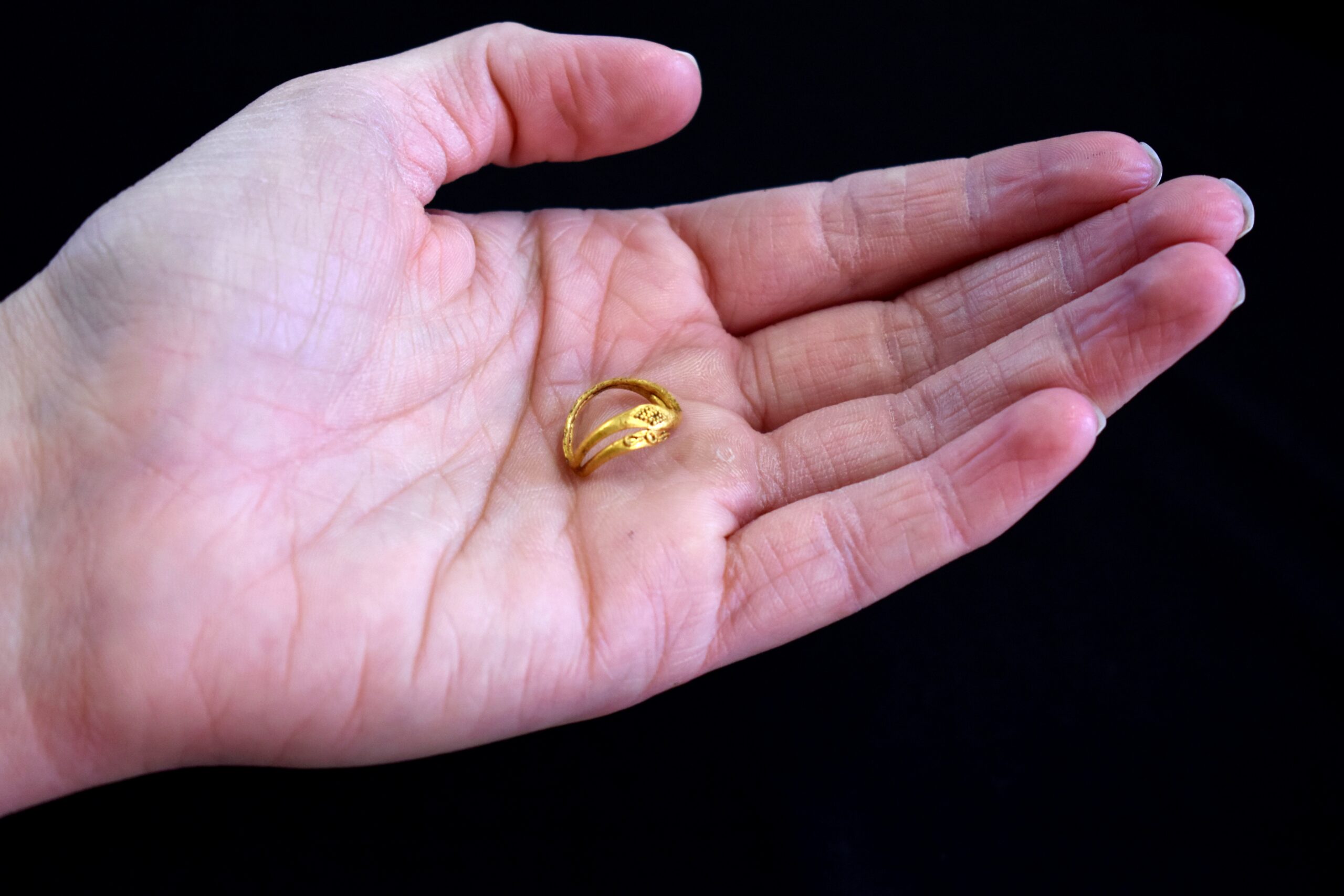
Pair of small Roman gold finger-rings, with close-up of the delicate decoration visible in left image and size denoted in right image.
One ring is decorated with 25 tiny gold pellets arranged in a diamond-shaped pattern. The other has a flat, elongated bezel decorated with fine strands of gold wire forming a central circle with drop-shaped motifs on either side, possibly representing a flower. Together, they are delicate, skillfully made objects, dating to between the 1st and 3rd centuries AD.
They are intimate finds, objects designed to be worn rather than displayed, and a reminder that the Roman city was not just made up of buildings, but of people and families who lived within them.
A decorated flue tile
Another intriguing find was a large fragment of Roman flue tile decorated with a roller-stamped pattern. Flue tiles formed part of the heating systems used in Roman heated buildings, where hot air generated by a furnace was channelled beneath floors and up through hollow spaces in the walls. This system, known as hypocaust heating, allowed rooms to be maintained at different temperatures and was most commonly used in bathhouses, although it could also be found in other high-status buildings. While plain flue tiles are relatively common finds on Roman sites, examples with decorative stamped patterns are much rarer, making this fragment particularly noteworthy.
What makes this fragment especially interesting is that the stamped design exactly matches examples recovered from the Roman bathhouse at Billingsgate in London. That bathhouse was built in the late 2nd or early 3rd century AD and remained in use until the early 5th century.

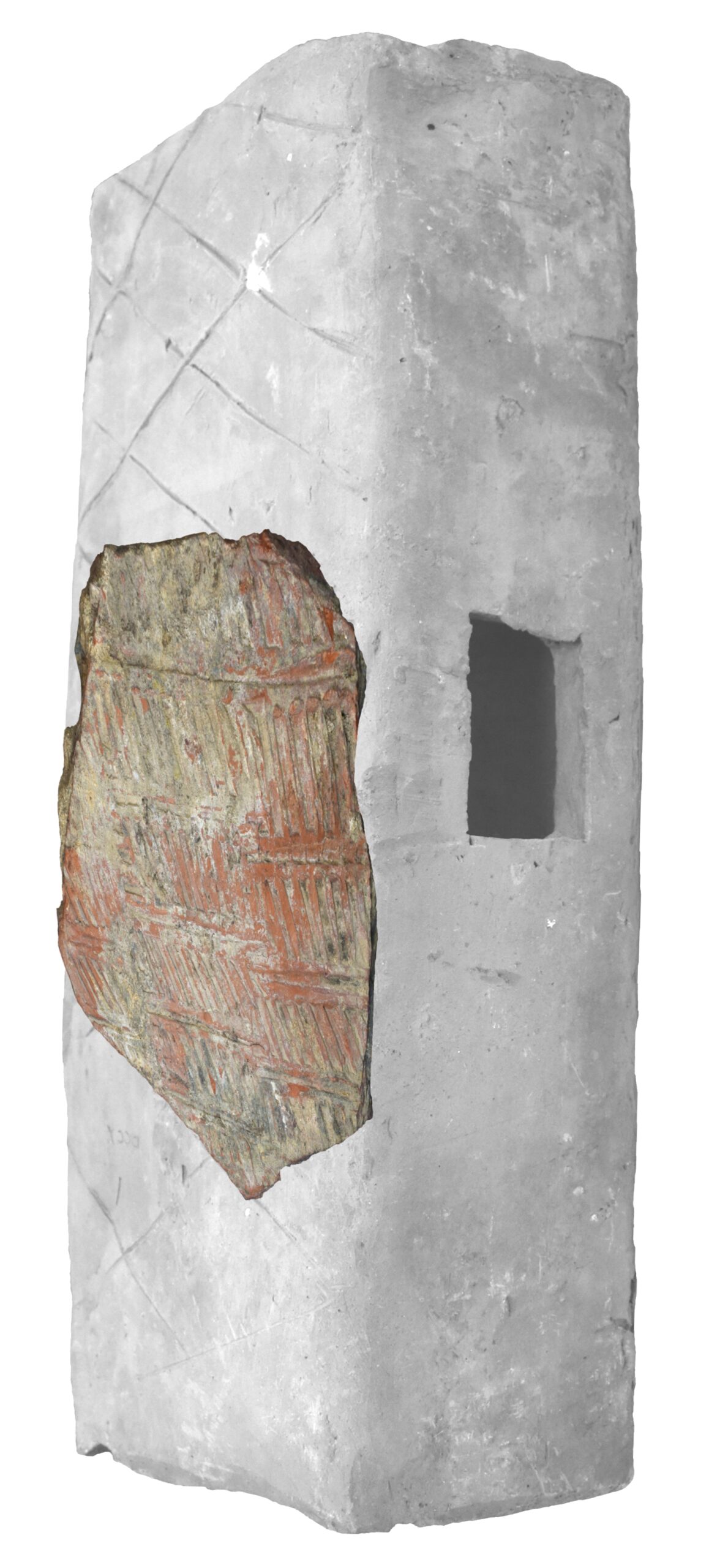
Left: CAT’s ceramics specialist examining the decorated box flue fragment. Right: The decorated box flue fragment overlaying a complete Colchester example.
There are several possible explanations for how identical designs ended up in both London and Colchester. The tiles could have been made in London and transported to Colchester, or the same tile maker may have worked in both settlements. Potters and tile makers in the Roman period were often itinerant, moving between locations or setting up temporary workshops. It is also possible that the wooden roller used to stamp the design changed hands and was later used by a Colchester tile maker.
As discussed in the previous post, excavations in 2019 beneath the former Jacks store, now Three Wise Monkeys, led to the suggestion that the remains of a substantial Roman public building in Insula 30 could represent part of the city bathhouse. This interpretation was based on the presence of substantial stone foundations and large quantities of broken flue tile, indicative of heated rooms such as a caldarium or tepidarium, where hot air circulated beneath floors and up through wall flues. More recent work has suggested that these remains could instead form part of the forum basilica. In this context, the decorated flue tile recovered from St Nicholas Square does not resolve the question, but it provides additional evidence for heated Roman buildings in this part of the city and slightly strengthens the case for public bathing facilities being located somewhere within the wider area.
Marble from across the Roman world
The most substantial and important group of finds from St Nicholas Square was a large assemblage of Roman marble and other decorative building stone. In total, 98 pieces were recorded, including fragments of paving and thin architectural veneers that once lined floors and walls. Together, they provide valuable evidence for how some of the most impressive buildings in Roman Colchester were decorated.
The significance of the marble recovered at St Nicholas Square is clearer when set alongside discoveries nearby. Just 60 metres to the north-east, at the former Kent Blaxill site on what is now 101–103 High Street, around 1,700 pieces of Roman marble and ornamental stone were recovered in 1952, making it one of the most important assemblages of Roman decorative stone found in Colchester. Significant quantities of marble have also been recorded elsewhere within Insula 29, the city block in which St Nicholas Square is situated. These include finds reported by William Wire in 1849 from a site opposite St Nicholas church, material recovered during works at the former Colchester Co-operative Society building in 1925 at the corner of Culver Street East and Long Wyre Street, and repeated mid-20th-century observations that marble was frequently encountered whenever St Nicholas Passage was dug up.
Archaeologists use the term “marble” broadly to describe any stone chosen for polishing and decorative effect, not just true geological marble. It is this wider definition that applies here.
The marble had multiple decorative uses within Roman buildings. Some pieces formed part of opus sectile floors, which differed from mosaics in that they were made from carefully cut pieces of coloured stone rather than small cubes (known as tesserae). These stones were shaped into geometric forms such as triangles, squares and elongated rod-shaped elements, and fitted together to create intricate floor patterns. Other fragments were thin panels or veneers, used to line walls or other architectural features. Both techniques were labour-intensive and relied on access to high-quality stone, so are indicators of wealth and status. Precisely because of their value, such materials were often removed, broken up or reused.
Detailed analysis of the St Nicholas Square assemblage identified thirteen different rock types, twelve of which could be traced to specific geological sources. Some were local stones from southern England, while others came from much further afield, revealing Colchester’s access to an impressive network of trade and supply.

Native Purbeck marbles (limestone) with Image 1 showing freshwater gastropod inclusions and Image 2 showing white Unio bivalve inclusions.
Large quantities of native Purbeck marble and Kimmeridge stone from Dorset were present, underlining the importance of British stone in decorative flooring within the Roman city. Alongside these were imported marbles from Greece, Egypt and Turkey, including bright white, deep green, red, purple and black stones. These were prestigious materials, widely used across the Roman Empire to decorate important public buildings and the homes of the wealthy.
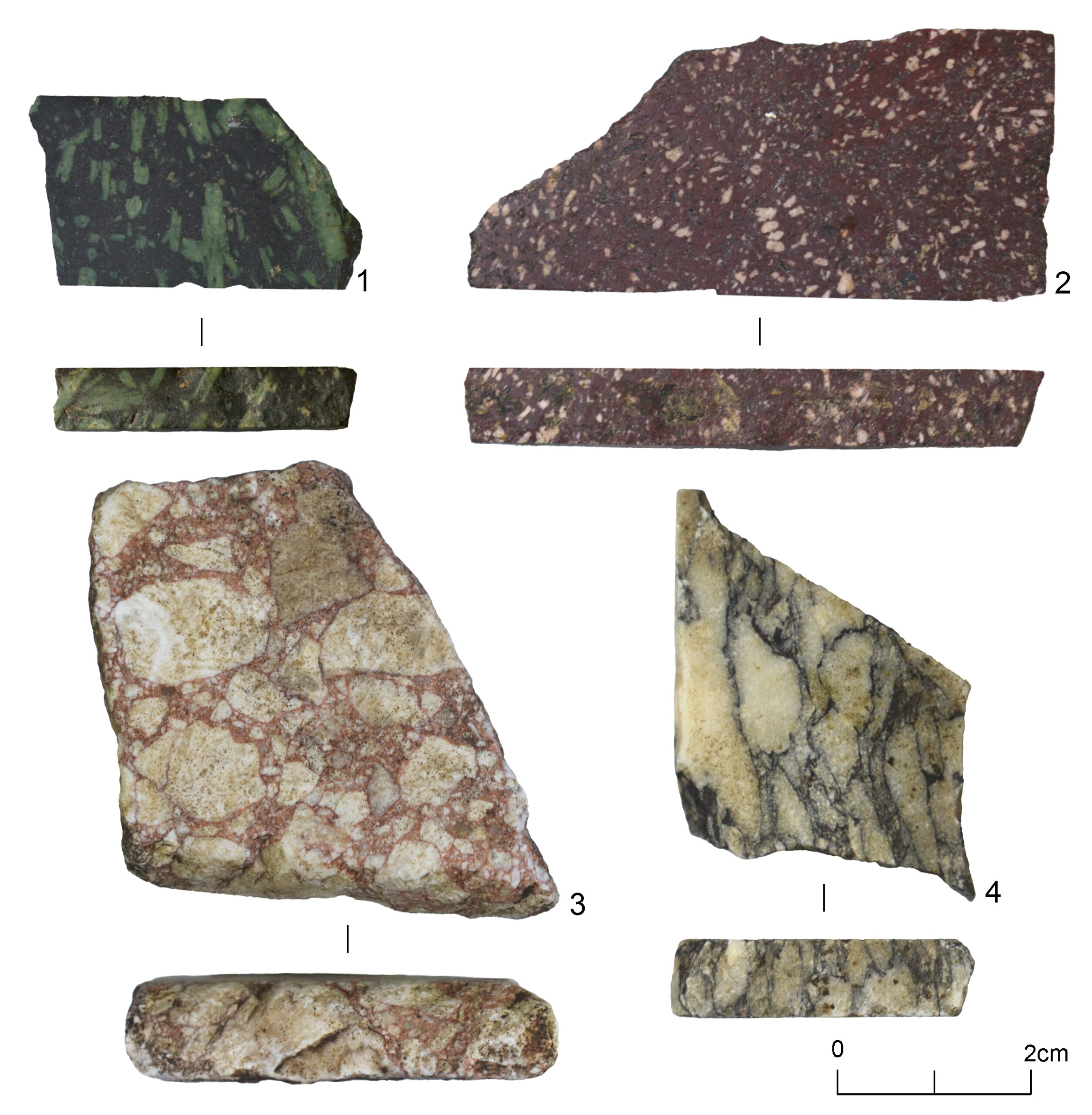
Imported marble used to decorate public buildings and the homes of the wealthy: Image 1 from Greece (Sparta porphyry), Image 2 from Egypt (Purple porphyry), Image 3 from northern Turkey (Breccia Corellina) and Image 4 from west-central Turkey (Pavonozetto)
Many of the fragments had been carefully worked and finished. Some were polished to a high standard, others cut into precise geometric shapes, and several preserve traces of mortar on broken edges, showing that they had already been reused before finally being discarded.
The variety of stone types, colours and forms demonstrates that these fragments came from many different floors and decorative schemes across Roman Colchester. While some of the material may have come from the dismantling of Roman buildings immediately adjacent to the site, the volume and range of stone found here suggest that it represents more than the stripping-out of a small number of buildings. One possibility is that marble was being gathered here for reuse, perhaps linked to nearby workshops where decorative stone was cut down and repurposed for new buildings. Untangling these processes will require further investigation.
Specialist analysis of the marble assemblage was undertaken by Dr Kevin Hayward, freelance archaeological building material specialist.
