Our Blog
Roman public buildings at the St Nicholas Square site
Jan
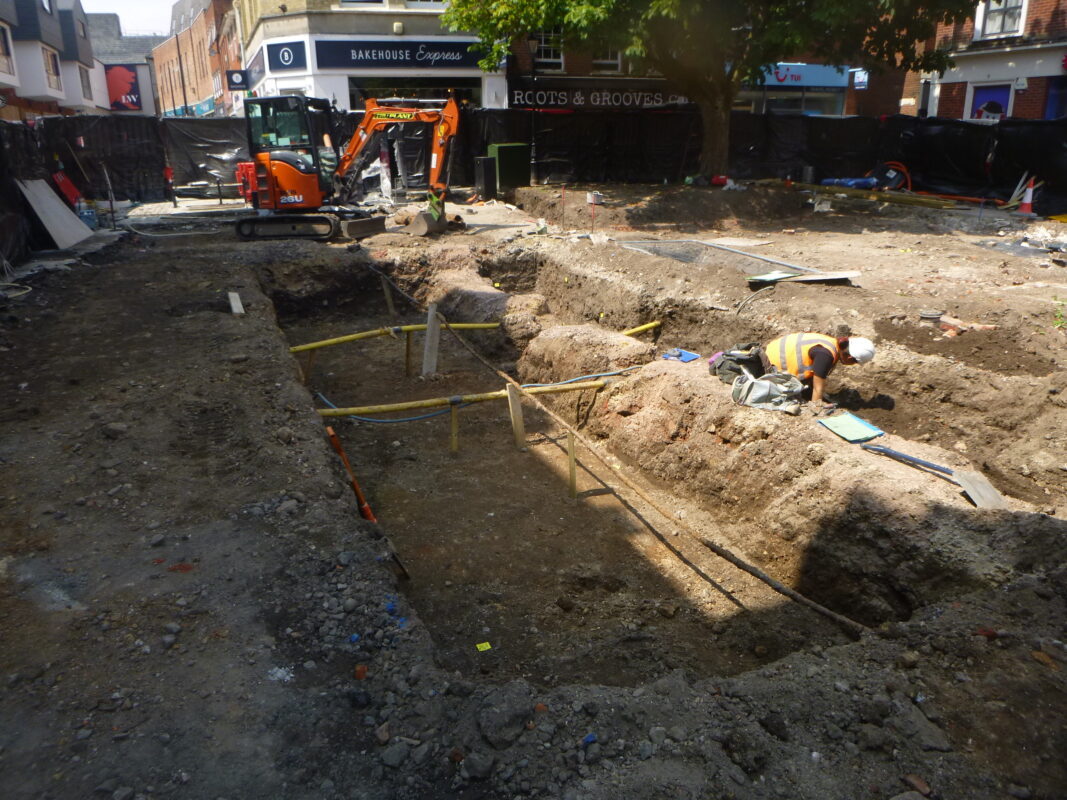
Archaeological investigations were carried out by Colchester Archaeological Trust at St Nicholas Square, Colchester, Essex, between October 2023 and June 2025, as part of groundworks for the redevelopment of the square into a new public space in the heart of the city.
When we began archaeological work on this site, we already knew it lay within an important part of Roman Colchester. What we did not know was quite how much of the Roman city still survived beneath the former St Nicholas church cemetery and surrounding roads, or how clearly it would echo discoveries made nearly seventy years ago.
The site lies at the heart of the Roman walled city, straddling two Roman city blocks, known to archaeologists as insulae. Between the two insulae, numbered 29 and 30, ran a Roman street aligned north to south, forming part of the regular grid that once structured the city.
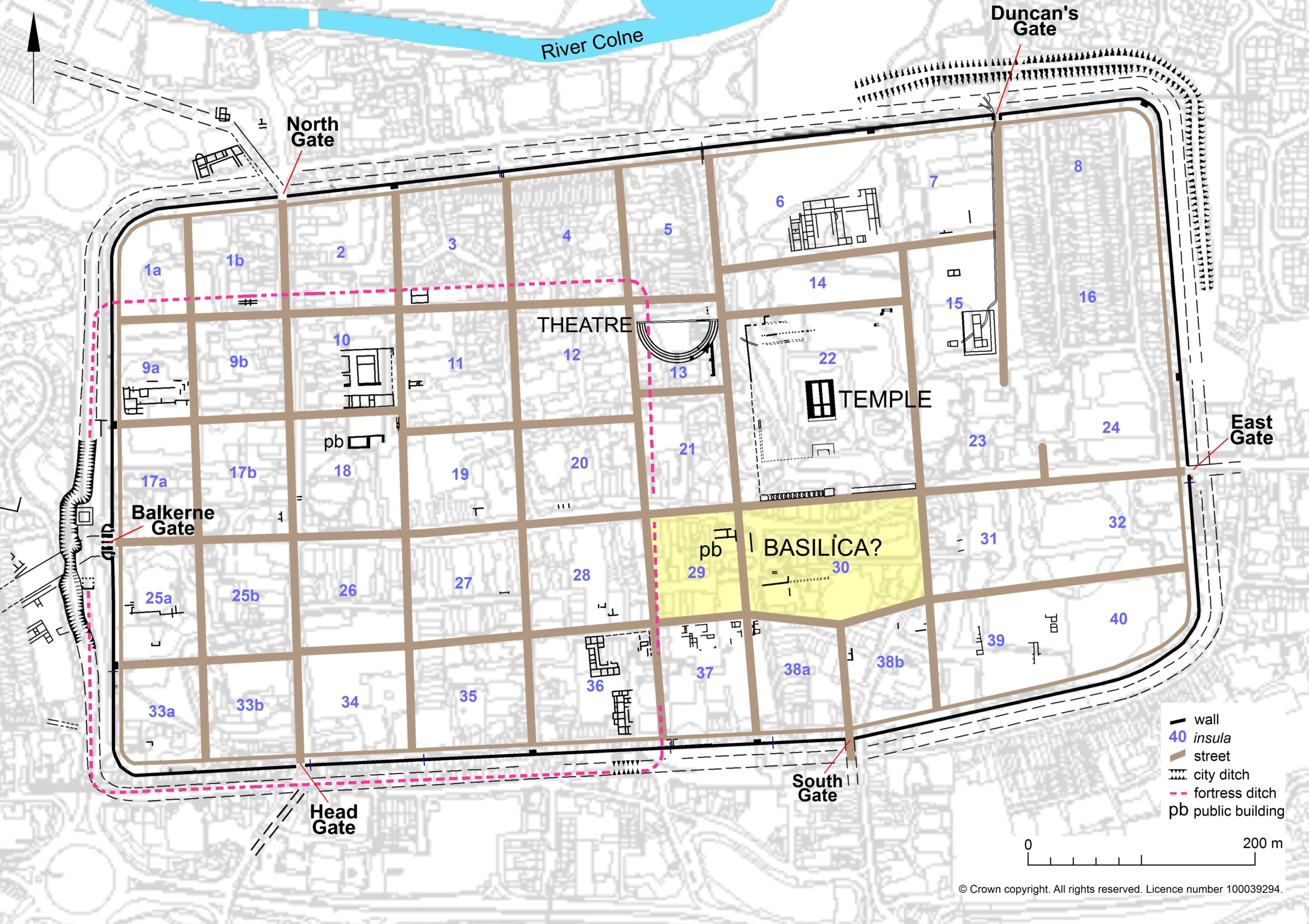
Roman City with Insulas 29 & 30 highlighted
What was already known
The last significant archaeological work here took place in the winter of 1955–56, when the Victorian church that stood on the site was demolished. This building represented the final phase of a much earlier church, first established in the 12th century and rebuilt in the 14th century before its late 19th-century reconstruction. The excavation was led by Rex Hull, a former curator of Colchester and Essex Museum, and lasted only about a month. It was carried out in difficult conditions and with very limited resources.
Even so, Hull identified key features, including the Roman street running between the two insulae and the remains of early Roman buildings constructed from timber and clay blocks. These early structures were destroyed during the Boudiccan revolt of AD 61 and later replaced by much larger masonry buildings, probably public buildings rather than private houses.
Hull also noticed something intriguing. The Victorian church walls had been built directly on top of Roman foundations. No medieval church walls were identified, leading to the suggestion that earlier churches on the site may have reused standing Roman walls. This provides a reminder of how the Roman city continued to shape Colchester long after the end of Roman rule.
What we found this time
Our recent work allowed us to revisit this picture and, importantly, confirm that Hull’s interpretation was broadly correct.
The recent excavations revealed evidence for substantial Roman buildings on both sides of the north–south street, within Insula 29 to the east and Insula 30 to the west. In Insula 29, we uncovered a substantial Roman wall foundation aligned north to south. It was over a metre wide and nearly a metre deep, built from tightly packed blocks of local septaria, a stone derived from the London Clay and commonly used for building in the Roman period, set in mortar. This was not the wall of a small house. Its scale and construction strongly suggest it formed part of a large, important building, probably occupying the south-east corner of the insula.
Roman wall foundation shown by the area of yellow mortar and stone
To the west of this wall, we identified layers rich in broken clay blocks and demolition debris, the remains of earlier buildings destroyed during the Boudiccan revolt. These appear to be part of the same early Roman buildings recorded beneath the church during the 1950s excavations.
In Insula 30, much of the Roman masonry had been removed in later periods, leaving behind long robber trenches where walls had once stood. These trenches follow the same north to south alignment recorded by Hull and mark the outer wall of another very substantial building. Taken together, the remains suggest a structure extending for at least 57 metres, again far too large to represent an ordinary Roman townhouse.
Additional robber trenches and a surviving floor surface made from crushed tile and mortar, a material known as opus signinum, were found nearby. These features almost certainly belonged to the same post-Boudiccan building, reinforcing the idea that this part of the Roman city was dominated by large, probably public, structures.
Traces of the earliest Roman buildings
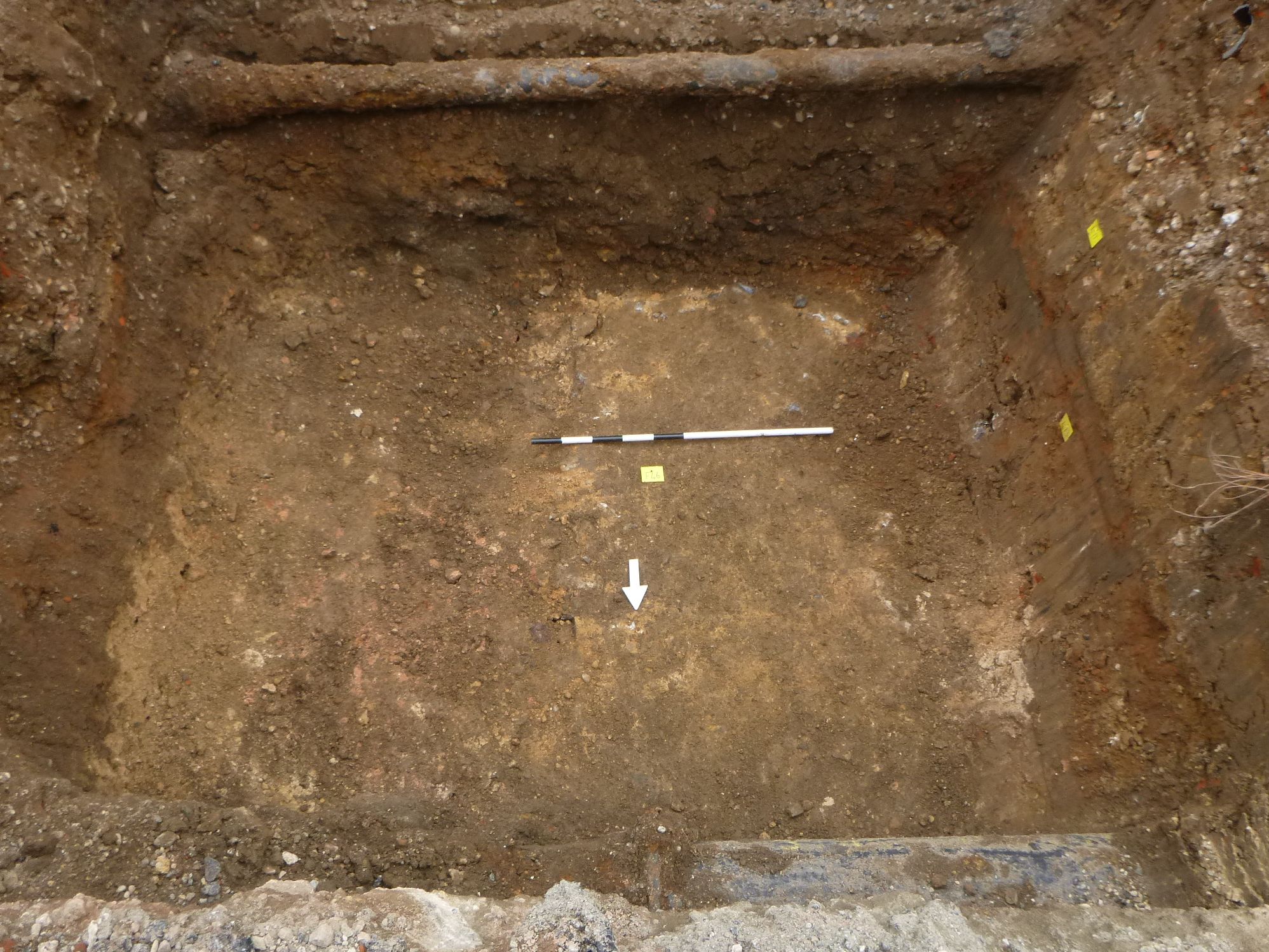
Opportunities to explore the very earliest Roman layers were limited. However, in a small number of deeper excavations we identified patches of Boudiccan destruction debris, the collapsed and burned remains of buildings destroyed during the revolt of AD 61. This deposit typically consists of fragments of clay walls, often fired red by heat, charcoal from burnt timbers, and broken roof tiles. Together, they represent physical evidence of the city as it existed before its dramatic destruction in the mid-1st century AD.

Boudiccan destruction debris in one of the deeper excavations shown by the red and black material towards the base of the section
The Roman street
The excavation also confirmed the survival of the Roman street running between Insula 29 and Insula 30. Just over 1.8 metres below today’s ground level, we recorded the gravel layers of the street. Around 60 centimetres thick, this was a solidly built street, laid out nearly two thousand years ago and still recognisable beneath the modern city.
A city rebuilt
Taken together, the archaeological remains observed at the site reflect a familiar but powerful story. Early Roman Colchester, built largely from timber and clay, was violently destroyed during the Boudiccan revolt. In its aftermath, the city was rebuilt on a grander scale, with large masonry buildings carefully aligned on an expanding street grid.
The evidence also reinforces the idea that areas of Insula 29 and Insula 30 were dominated by large public buildings. What these buildings were remains uncertain. During the excavations beneath the former Jacks store (now Three Wise Monkeys) in 2019, the building in Insula 30 was suggested to represent the city bathhouse. More recently, work by Philip Crummy has suggested it could instead form part of the forum basilica. In Roman cities, the forum was a large open public space used for markets and commerce, while the basilica typically formed part of the same complex and was used for courts, administration and official gatherings. Further archaeological work will be needed to better understand the role and purpose of these buildings within the Roman city.
