Our Blog
WORK EXPERIENCE – ALEX
Apr
A blog post written by Alex, a student at the University of Reading, who completed a work experience placement at CAT in 2023-2024.
Hi! My name is Alex and I have been on a placement with Colchester Archaeological Trust since October 2023, whilst studying an MA Archaeology at the University of Reading. I made the decision to embark on this placement as I come from a non-archaeological background and I wanted to gain some real world, practical experience. Archaeology is such a specialised field in a competitive field, so I wanted to gain as many practical skills as possible to complement what I’ve been learning in the classroom.
CAT felt like the perfect choice. I’m an Essex boy born and bred, and have been immersed in the history of Colchester from an early age. I’ve always been aware that the Roman Circus Centre and have even had the occasional coffee and cake in the cafe on my adventures round the town. Little did I know how much archaeological work was going on behind the scenes!
My time at CAT has been an unbelievably varied and rewarding experience. Each day I have learned something completely different, which I understand may not be the case in other archaeological units where skills are more compartmentalised. Every day has been an adventure.
As a Post-Excavation placement, I have been involved in the processing of finds that arrive at CAT following on-site fieldwork. This is a very important role, as we have been responsible for ensuring that artefacts from excavations are in a suitable condition for analysis. Finds dug straight out of the ground are not immediately ready to be looked at until they have been washed. Finds washing has been one of my favourite activities – despite being rather monotonous and very dirty work, there’s something magical about being the first person in hundreds of years to see the red of Samian ware or the design of a medieval jug. It really takes you aback. There is also something quite therapeutic about slowly washing something of value, so it’s no surprise that people from all walks of life volunteer their services. A key skill I have learned is to recognise the subtle differencing in washing technique depending on the material of the finds, such as using a toothbrush to clean pottery but a sponge for more delicate artefacts. You gain a good understanding of the components of the materials and how fragile they are.
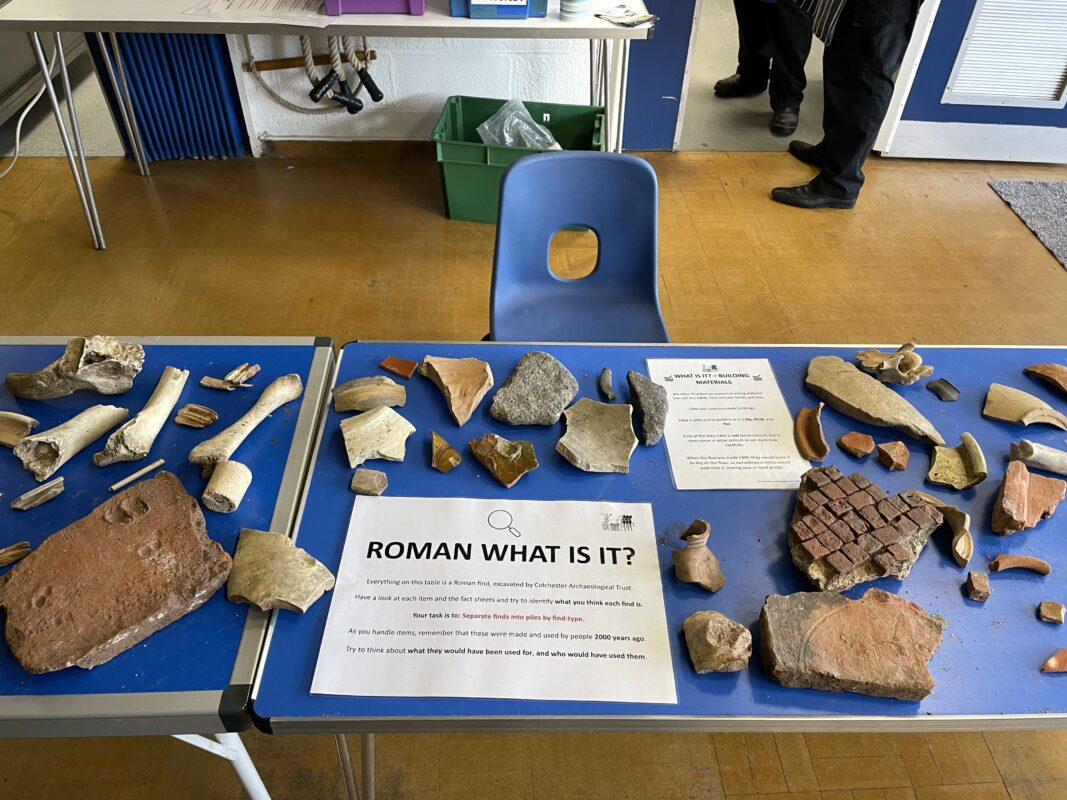
A hugely rewarding part of my placement was joining Vikki on a trip to a primary school to carry out some archaeological talks. We had two tables – one on the Bronze Age and one on the Romans – jam packed full of finds for the pupils to look at and touch. Everything from animal skulls and shells to fragments of vessels and even part of a tessellated floor, seeing how entranced and amazed the children were by our finds was incredible. I actively engaged by answering any questions the children had (believe me, there were a lot!), and one little girl even said she was inspired to become an archaeologist herself one day. Although it was quite challenging to deal with so many excitable children, I loved every part of the day and it made me realised how much potential archaeologists have for engaging and educating from an early age. It was also my first experience of handling and transporting such a large amount of ancient artefacts – I may have looked calm as I carried the fragile finds but inside I was screaming!
One of the most impactful moments during my time on placement was when I handled human remains. My first encounter was when I was finds washing and ended up cleaning a human toe bone. I felt uneasy at first, knowing I had in my hands a part of a person, however it was also one of the most moving moments in my life. It’s easy in archaeology to become immersed in artefacts and materials while forgetting that the discipline concerns the study of actual human beings. It was an absolute privilege to play a small part in understanding individuals from the distant past. For the record, I am also grateful to CAT for asking me beforehand if I was okay with handling human remains. It demonstrates that archaeological units are still consciously respectful of the people they are learning about.
I have also been actively engaged in the writing of Throwback Thursday social media posts, which look back on an interesting past excavation that CAT has been involved in. This has required in-depth research of CAT’s archives, unearthing fascinating facts about hillforts, burial mounds, Roman tombs and the ancient people associated with them. I was quite confident with this task as I’m social media savvy, but I still encountered some nuggets of information that I never knew about such as the wide variety of valuables in the Lexden tumulus. There is always something new to learn!
One way that I have definitely thrived is the routine, methodical nature of archaeology, which is essentially a science so requires strict procedures of conduct and practice. I am on the autistic spectrum so I tend to see things in black and white, which works to my advantage when there are strict rules to follow. This was certainly the case when processing finds – there is no room for error when maintaining an accurate record. I was fully comfortable in this environment.
One thing I would improve on from this placement would be a longer run of days at CAT, rather than one day here and another day there. There has been a lot of information and procedures to learn in a short space of time, which would have been much easier if I had a continuous period to let my brain absorb everything. Unfortunately this could not be helped due to my busy study schedule, so this is nothing against CAT at all.
Overall, I have absolutely no regrets about this placement. Seeing how archaeologists work on a day-to-day basis has been invaluable. I have already expressed an interest in volunteering my services in future, especially on school events. It’s been an experience that will stay with me forever. I am grateful to everyone at CAT for ensuring that I had a welcoming, comfortable and useful time.
