
Discoveries, Our Blog
#ThrowbackThursday 21 St Peters Street
Mar
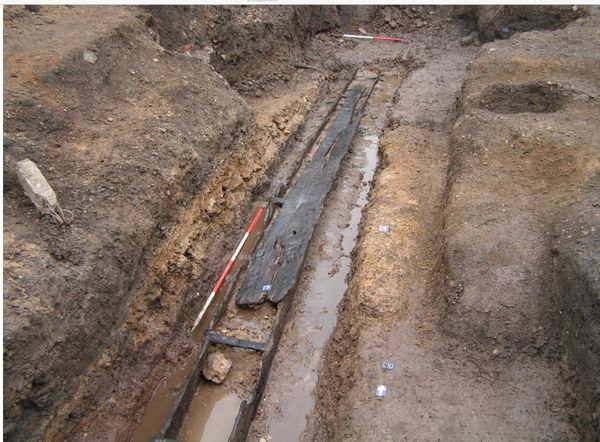
Today, our #ThrowbackThursday is remembering 21 St Peter’s Street, Colchester
Our work at 21 St Peter’s Street was carried out between November 2007 and February 2008. The site is within an archaeologically sensitive area. It is adjacent to the Roman town wall, to the east of the Middleborough site which produced evidence of Roman buildings and a major Roman road, and to the south of Roman masonry walls
Although this was a relatively small site, the investigation produced a series of interesting and significant results covering a range of issues. The bulk of the site is outside the Roman town wall and was expected in at least the Roman period to have been a kind of boggy ‘no man’s land’ between the wall and the southern edge of the town ditch about 10m to the north. However, the excavation revealed a much more complicated story😵
The centre of the site was dominated by part of a Roman street heading northwards. In AD 50-61, this was a thin metalled surface, it was likely destroyed but then re-established or relaid after the Boudican period. There are also drains on the east side that could have been added in this early period
The town wall was built c AD 65-80, and the drains were cut through and effectively rendered useless by the trench for the foundation of the new wall. The street continued in use until the late Roman period and was was re-metalled and repaired on various occasions so that the metalling became much thicker with time (as was normal). Presumably, although no direct evidence was found for its presence, the wall likely incorporated a gate and this explains the presence of the street
In c AD 275-300 the gate may have been blocked as happened to the Balkerne Gate. At a similar time, small pits with upright logs in the centre were dug into the street between the redundant gate and the town ditch. The most likely explanation for the pits is that they were lilia – defensive devices containing sharpen posts pointing upwards (Webster 1969; 176). Very few lilia have been found in Britain or abroad. The ?lilia from St Peter’s Street are not very firmly dated and there is a small but distinct possibility that they are post-Roman in date and hence not lilia at all
To learn more about this site, check out CAT Report 556 at cat.essex.ac.uk.
