Our Blog
#ThrowbackThursday Dunmow Road
Aug
Today we are remembering our work on Dunmow Road, Great Easton for #ThrowbackThursday.
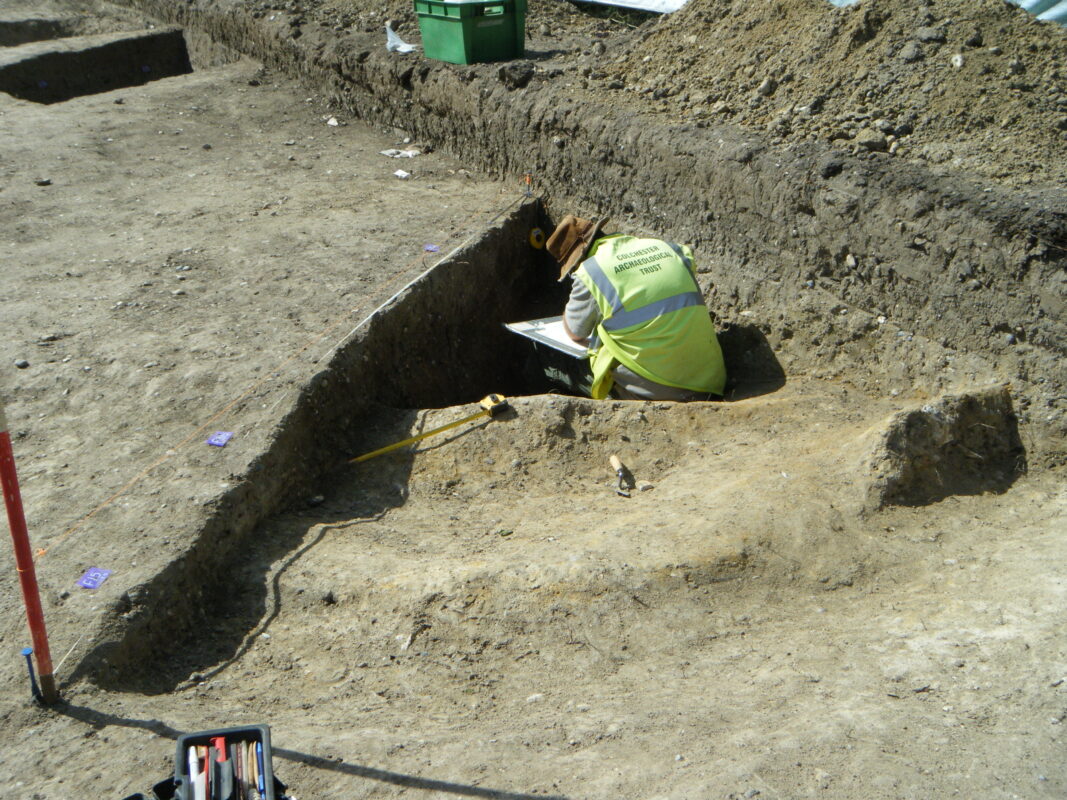
In 2011, CAT worked on an excavation in Great Easton ahead of the construction of a new workshop and showroom. The site was based in an interesting area, as evidence of human occupation (especially medieval remains) had been identified close to the site😮
Our work here identified Prehistoric activity, indicated by small pits, post-holes and a gully as well as significant assemblages of residual worked flints and prehistoric pottery sherds. It could be that this suggests intermittent settlement of the River Chelmer valley from the Early Neolithic period and throughout the Bronze Age and Iron Age👏
There was strong evidence of occupation of this site during the Late Iron Age and Roman periods, including ditches which have been interpreted as the line of an enclosure, probably surrounding a rural farmstead. These enclosure ditches as well as adjacent rubbish pits have also produced significant finds assemblages which suggest that the inhabitants of the farmstead undertook both animal and crop husbandry. This settlement was thought to be involved in activities such as food processing, preparation and consumption. Evidence suggests that the farmstead buildings were constructed of wood with wattle and daub walls and that the inhabitants of the farmstead were of a relatively low economic status. Occupation of the enclosure probably continued until the mid 3rd-4th century.
No evidence was found for the continued occupation of this part of the river valley in the Anglo-Saxon period and it is presumed that the site was abandoned following the Roman period. Moreover, despite its close proximity to medieval remains, none were uncovered on this site.
To learn more about this site, please check out CAT Report 608 at http://cat.essex.ac.uk/
