Our Blog
#RomanCircusBlog – Meg
Sep
Today we have a post from our Project Osteologist Meg about the Roman Circus’s potential uses other than for chariot racing..
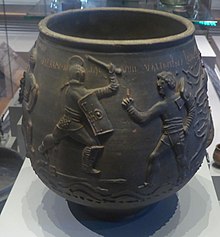
Did you know that at Colchester’s Roman Circus, as well as chariot racing, spectators could possibly have watched gladiatorial fights and individuals fighting animals (bestiarii)? These activities can be seen depicted on the Colchester Vase (pictured), where individuals are seen fighting other people, as well as a bear. Some people volunteered to be gladiators whereas others were forced into it, often coming from slavery or criminality.
But what did these gladiators look like? From the Colchester Vase we know they had weapons, helmets, and sometimes other minor pieces of armour. Very little archaeological evidence in Britain supporting this been found so far. The only item of gladiatorial armour found in this country is the Hawkedon Helmet, a bronze helmet found in Suffolk in 1966. Evidence of swords and armour have been found in Britain, but may have been used by Roman soldiers rather than specifically gladiators.
Osteological evidence of gladiators in Britain is also few and far between. No clear “gladiator burials” have been found in Colchester yet, however there are some burials elsewhere in England that have been suggested as gladiator burials. A small Roman cemetery excavated in York revealed 80 robust male skeletons, with one individual showing evidence of a large carnivore bite. Decapitations and hammer blows to the head were also seen, however a wealth of grave goods were also found. The leading theory is that these men were likely respected gladiators. A Roman cremation of a young adult female excavated in Southwark, London was theorised to be that of a female gladiator (gladiatrix). A lamp depicting a gladiator was found in the cremation, as well as remains of rich food and other wealthy grave goods.
In Colchester we have yet to find any clear evidence of gladiator burials, but as we know gladiatorial fights likely took place at the Roman Circus it’s possible gladiators lived and died in Colchester.
#RomanCircus20 #archaeology #Colchester
