Our Blog
Roman Circus 20th Anniversary🥳
Jan
For the first #ExploreYourArchive day of 2024, we would like to take a look at the one, the only, Colchester’s Roman Circus 👷♀️
With it being 20 years since Colchester Archaeological Trust’s main excavation of the Roman Circus site, this year is a particularly important one in our history. We might not have known it previously, but by 2004, we knew that we had unearthed Britain’s only known Roman Circus. It was used between roughly the 2nd century AD and the late 3rd century, for chariot racing amongst other spectator sports.
Other circuses have been discovered around the world such as the Circus Maximus in Rome. They are recognisable by their unique shape which allows for features including the race track, central barrier (known as the spina), and tiered seating (known as a cavea). These large open-air venues were important for events that drew huge crowds in the Roman period.
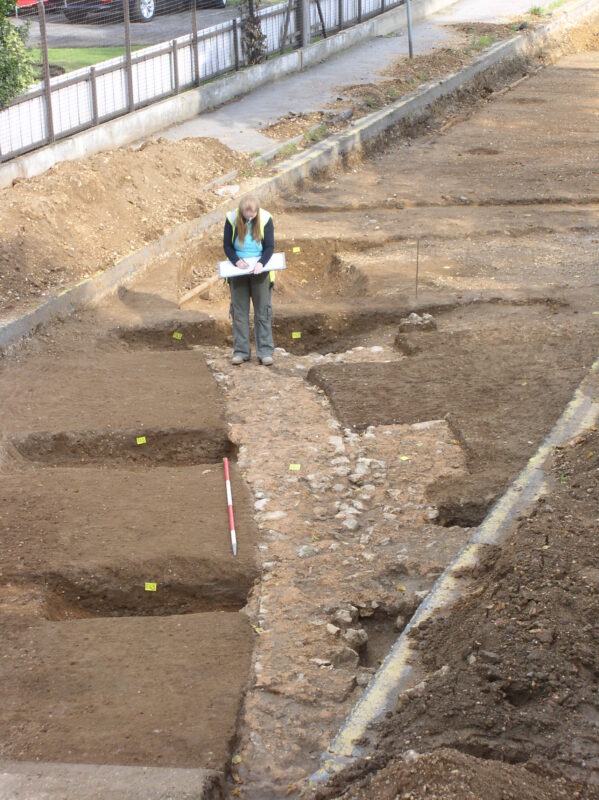
The excavations of Colchester’s Roman Circus revealed the wall foundations and foundation cut of the Circus, but unfortunately, there were no upstanding walls remaining. In fact, most of the stone was robbed out during the medieval period. However, the foundations were enough to understand that it was 450m in length with a race track about 2.5 miles long (if you raced round it 8 times!), and had a capacity of 8,000-16,000 people.
Some memories of the CAT staff who worked on the site include:
Laura:“I can’t quite believe it’s been 20 years already. The year 2004 was an exciting one. Excavations across several areas of the old Colchester garrison had revealed hundreds of Roman burials, but also included several long and straight sections of Roman wall that had us all scratching our heads. It was hard to believe our Director Philip Crummy when he initially told us that these walls could be part of a circus. However, the more we dug, the more evidence we found. Now whenever someone asks what is the best thing I’ve ever found, I always say I was part of the team that discovered Britain’s only known Roman circus.”
Ben:“It was a great privilege to have been one of the team leading these excavations in 2004. Apart from it being brutally cold (it was mid winter after all!) one of the stand out memories for me (and there were quite a few on that project!) was the moment the penny dropped as to what was going on. We had a site meeting with Philip (the director of CAT), the client’s consultant Rob and someone from Taylor Wimpey’s PR team. We were talking about the unusual long stretch of buttressed wall. There were various theories, the boundary wall of the burial ground or marking a boundary within it, and the possible foundation of granaries that may have supplied the town. It was a throwaway remark from the PR man who said “I know what this is for – it’s for racing horses!” It was at that point that Philip went very quiet and didn’t say much else for the rest of the meeting. When we returned to the office, he had us get together all of our working plans where similar buttressed walls had been seen and Philip started putting together his theory: the largest Roman building in Britain and the first known Circus, which subsequent investigations have proved correct.”
Emma: “When I first started hand planning (plotting the location of all the stone chippings etc using a gridded frame) the remains of a substantial wall with buttresses across the corner in 2004 we had no idea what it related to. As it was in the northern edge of the site we could not follow it to see where it went. My trusty 6h pencil, tape measures, drawing board, planning frame and I followed the trail of each trench and excavation area revealing the circus bit by bit, from the eureka show me every plan of the area, to confirming stage by stage that yes it was a circus! I have recorded the foundations of the walls, buttresses and one of the turning posts, took out a small team of volunteers to excavate part of the starting gates to confirm the orientation, and worked on plans and illustrations of the remains and related artefacts for reports and articles. Sometimes I ponder how many stones and tile fragments I planned over all those years… But the highlight for me was recording the bend of the circus under Napier Road when the remains were the clearest and drawing and photographing the beautiful enamelled horse harness fitting found under Napier Road.”
Colchester’s Roman Circus lays on an east to west orientation, between roughly north of Le Cateau Road and Arena Place, Napier Road. A section of the buried remains can be viewed at the Roman Circus Visitor Centre.
During the summer, we will be conducting some events to commemorate the anniversary of the Circus excavations, so keep your eyes peeled on our website and social media for any updates 👀 We are so excited #RomanCircus20 🥳🥳🥳
@exploreyourarchive #dustbusters


