Our Blog
#FindsFriday Deviant burials
Feb
This #FindsFriday our Project Osteologist Meg will be discussing a type of burials known as ‘deviant burials’
So, what is a deviant burial? Deviant burials are where an individual may have been buried in an unusual or atypical way. They have been found worldwide up until the 12th century, but are fairly common practice in Roman Britain and Anglo-Saxon England.
Common examples of deviant burials include face-down (prone) burials, decapitation burials where the head may be placed elsewhere in the grave, and stones placed in mouths. Deviant burials are usually found outside of the main cemetery grounds, sometimes without coffins.
But why do it? There are many theories as to why, but deviant burials are generally thought to be punishment burials. May be to punish the individual for a crime committed, and/or to prevent the individual from “rising” again, either to terrorise the community, or to spread an infectious disease they had. This may have been where the idea of vampires and witches came from!
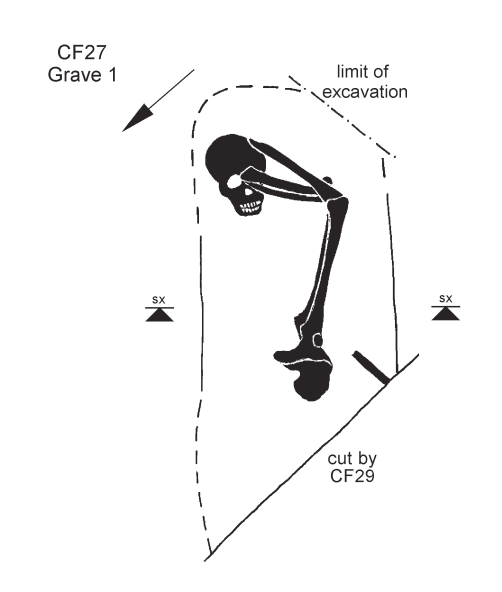
This image depicts a young female adult (CF27) from the Garrison site, that was found with her head placed at her feet in the grave (CAT Report 412). It is likely her head was removed after death, and placed between her feet at the time of burial.
